Ask any private lesson teacher what they love about the job, and you’ll hear about the lightbulb moments: the first clear note, the etude that finally clicks, the student who decides music is in their future. Ask what they dread, and you’ll hear about invoices, reminders, and the awkward text to a parent who hasn’t paid in a month.
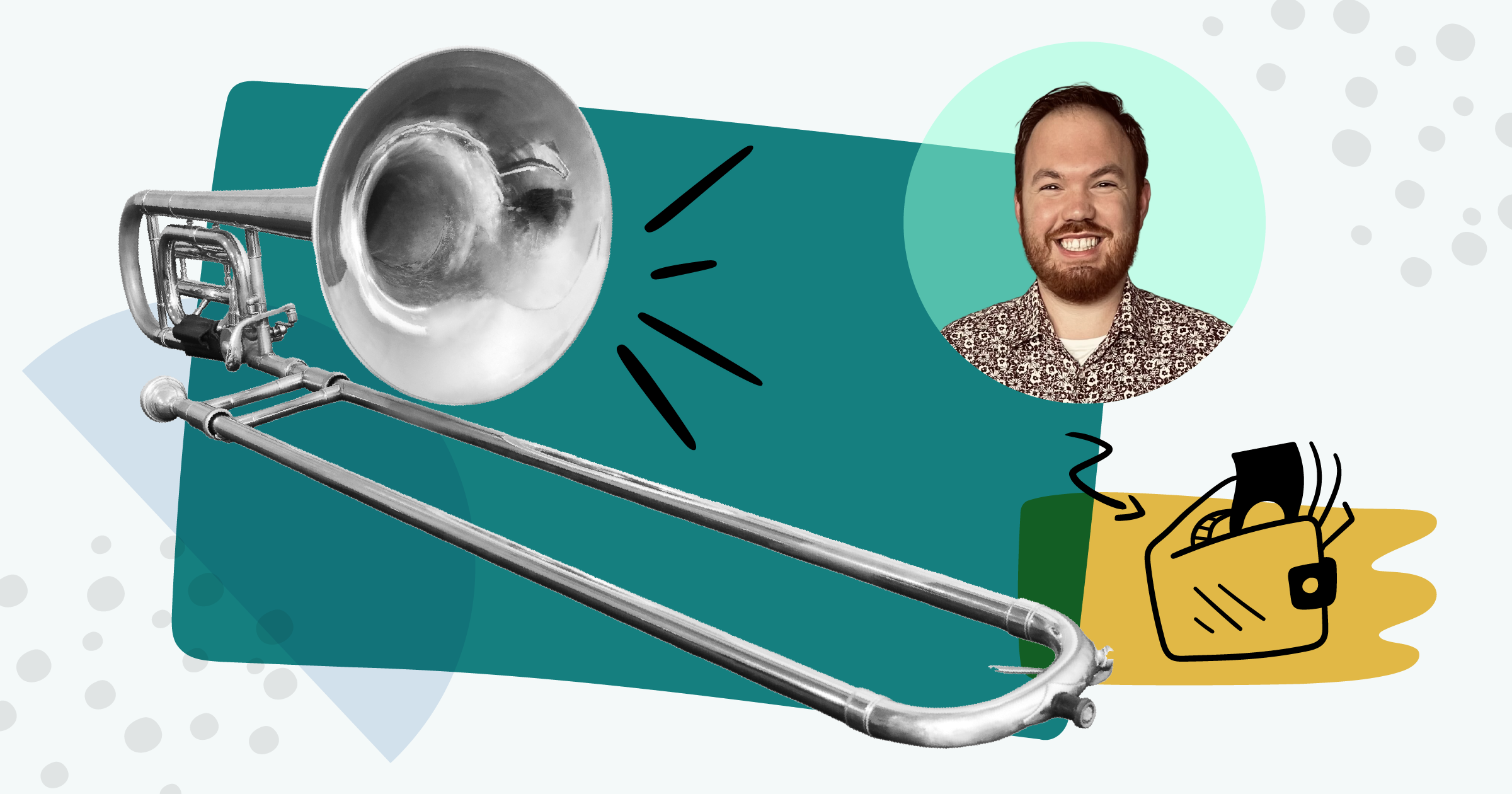
For Carter Richardson, the teaching has never been the hard part. Over seven years in San Antonio, he has built a studio of about 50 trombone, euphonium, bass trombone, and tuba students, nearly all within one cluster: Ronald Reagan High School and its two feeder middle schools, Lopez and Bush in North East ISD. Last year, six of his seven graduating seniors went on to major in music or play in their college ensembles.
The business side was another story. Here’s how MakeMusic Studio helped one teacher stop thinking about the “businessy part” and get back to what he does best.
A Studio Built Inside the Band Hall: From First Buzz to College Ensembles
Carter’s lessons don’t happen in a home studio across town. Almost every lesson takes place in a school, during the student’s band class period, with a few sessions before and after school for high schoolers.
That range is wide. One hour he’s working with a beginner who just wants to play anything at all on their instrument. The next, he’s preparing a senior for college auditions. A handful of graduates, deemed his “grad students,” still come to him for lessons as they chase goals like drum corps.
He also runs two auditioned chamber groups, a euphonium quartet and a trombone quartet. They give students a chance to apply lesson skills, like tuning the fifth of a chord, in a real ensemble before taking them back to their wind ensembles. He’s even coached a group to the annual Fischoff chamber music competition in South Bend, Indiana.
“We are just forty-five to fifty minutes in a box once a week,” Carter says. “Now we’re in an ensemble room or we’re on a stage, and that is a very very fun part of each week.”
The Texas Calendar: Teaching in Step With the Band Director
In Texas, a low brass studio runs on the band calendar. All State music arrives in mid-July and the high school audition process lines up almost exactly with marching band season. Things get busy quickly. Carter’s message to hush high schoolers is simple: learn every note and rhythm as early as possible, at whatever tempo, so lessons can focus on style and musicality.
“Future Tommy is gonna love the work that past Tommy did,” he tells them. “You don’t want future Tommy to be hating past Tommy.”
His middle schools run on a highly structured schedule of weekly pass-offs, sectionals, and chair test excerpts. Early on, Carter tried to set his own pace. He quickly changed course. “The kids want to do what their band directors tell them to do,” he says. “We don’t need to go any faster than their schedule. Let’s make them just super, super good at the chunk they’re expected to work on.”
That respect for the director’s plan is also how he got into those band halls in the first place. A friend teaching trumpet lessons in the same district recommended him to the Bush Middle School director, who set one condition: teach a particular student to articulate. That student can articulate now, and he’s one of Carter’s “grad students.”
His advice for building those relationships: “Don’t have the first time that you talk to that person be the time that you’re asking them for something.”
The Business Side: “Can’t We All Just Live Off the Earth?”
By his own admission, Carter would happily skip the business side altogether. “I just want to teach the lessons,” he says. “If somebody was like, here are the students, that would be perfect.”
Before MakeMusic Studio, his billing was patchwork. Some parents sent in a monthly check. Others paid through Venmo requests or Zelle. Contact details were scattered, too: a phone number for one family, only an email for another. Tracking it all for taxes was a constant headache, and he estimates it took about 30 minutes every day to maintain, “if not more.”
The real cost showed up when payments slipped. “It wasn’t really a problem until it was a problem,” he says. As an educator, he wasn’t willing to turn a student away, so sometimes he simply kept teaching a student whose family hadn’t paid in four weeks.
Parents didn’t love the system either. Their kids just show up to band class on Thursday and Mr. Richardson is there, so remembering a separate payment felt like one more chore. “They just wanted it to be like, okay, I bought my Spotify,” Carter says.
With Carter teaching eight to ten hours of lessons a day, there was no time left to send a dozen reminders through a dozen different channels.
The Switch: One System Parents Already Recognized
Carter moved his studio to Fons, now MakeMusic Studio, three and a half years ago. Families had spent years answering his Venmo requests, so they welcomed the change.
The only hard part was cleaning up his old records: gathering missing emails and phone numbers into one place. After that, adding new students became routine. A typical year brings about 10 new students, trickling in across the semester.
The MakeMusic name helped, too. His band programs already use MakeMusic accounts, so parents saw a familiar tool. “It’s easy, this is the same thing,” Carter says. Studio is also free for families, and many rarely need to log in at all.
The Pricing Recipe: Packages That Carry Through the School Year
Carter keeps billing simple: two pricing options, plus two automations that do the follow-up for him.
- Per-lesson billing: The card on file is charged automatically just after each lesson.
- 10-lesson packages: Families pay for nine lessons and get ten. It’s his discount option and fits the school year well.
- Automatic reminders: Families get a lesson reminder (automated by Studio) two days ahead, so fewer lessons slip their minds.
- Low-balance prompts: When a package runs low, Studio emails the parent to buy another with one click.
The package math works in his favor. A school year has about 36 weeks, which doesn’t divide evenly by 10. Families who have prepaid lessons tend to keep coming through the last weeks of school, and are more open to summer lessons or an early start in the fall. “We don’t have to buy a thing, we’ve done it already,” he says. “It’s just human nature. I do it too.”
The Results: A 1% Cancellation Rate and One Source of Truth
Asked about the biggest change since switching, Carter doesn’t hesitate: cancellations. Leaving out school conflicts like contest days, he estimates his cancellation rate is now about 1%, and possibly lower. In all of October, he had a single no-show, and that student was home sick.
“It just used to be so easy to forget about it,” he says. “With MakeMusic Studio, they get the reminder, they’re getting the email that their lesson package balance is getting low. It’s just these little reminders that keep everyone more involved and on the same page.”
The payment chasing is gone, too. “There are zero problems ever,” Carter says. “Everyone likes it. It’s better on both sides.”
With about 90% of his income now running through one system instead of three, his reporting finally works for him. He can see which teaching day is most cost-effective, compare what he spends getting to each campus, and pull everything together at tax time. “It just gives me every piece of information that I need,” he says.
Beyond the Ledger: Practice Tools for Beginners
Studio’s music library has become a weekly resource for Carter’s youngest students. Beginners’ abilities change so quickly that a fixed packet, like he provides to his older students, can’t keep up. Instead, he checks each week what his students can do and pulls a fitting exercise, like the spooky Halloween or rock-and-roll long tones.
He also keeps his own packets in the library, so students can always find them. Next on his list: adding the All State music when it comes out in July, so his high schoolers can practice with it at home.
Advice for Teachers on the Fence
Carter’s advice to other teachers is blunt. “If you spend more than five minutes thinking about scheduling or payment in a week, then you deserve that time back.”
At about $20 a month, he points out, MakeMusic Studio costs less than one lesson. He recommends it to every lesson teacher he hears sending Venmo requests. “Just do it,” he says. “It is just simple and so much better than everything else.”
Reclaim Your Teaching Time
Spend your week teaching, not chasing payments. Start your free MakeMusic Studio trial and see how automatic billing, reminders, and packages can work for your studio.